
High-temperature resistant materials
Tailor made solutions for customers and create more innovative products for them


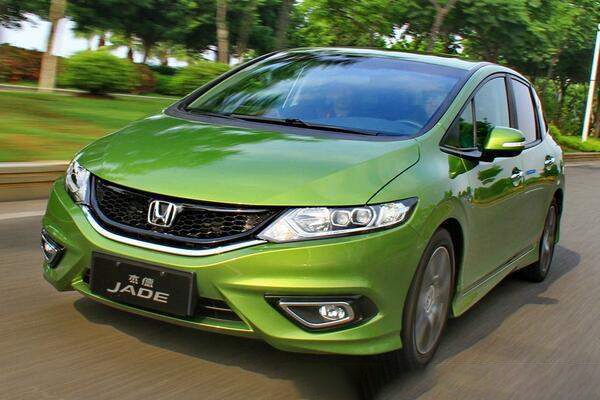
Pigment green 36: yellow light phthalocyanine green, particularly bright yellow light green, mainly used for automobile original paint, metal effect use, such as Honda Jed bright green effect, bright yellow light green after adding silver powder. It has high temperature resistance, high weather resistance, acid and alkali resistance, and the ultimate temperature resistance is more than 300 degrees. Due to cost reasons, it is currently mainly used in the field of handicrafts.
Thyssen new material electronic color card:

Thyssen No. 36 green pulp, can correspond to Pantong color card tone, 802C, 7487C, 7488C, 375C and other colors
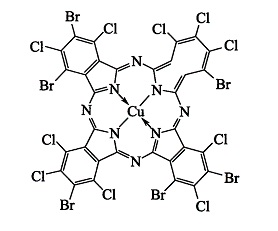
Registry number: CAS[14302-13-7]; CI 74256 Molecular Formula: C32Br6Cl10CuN8 Molecular Weight: 1394.0 Structural Formula:
Quality Standards:
| appearance | Yellow, dark green, paste-like liquid |
| Shade | High chroma yellow green (apple green) |
| Pigment content/% | It is 100±5 of the standard |
| Oil absorption/% | 30 |
| Moisture content/% | ≤0.2 |
| Fineness/% | ≤ 5 μm |
| Water soluble matter content/% | ≤0.2 |
| Light fastness/class | 7~8 |
| Heat resistance/°C | 300 degrees |
Pigment properties: This product is a yellow light dark green powder. The color is bright and the tinting power is strong. Insoluble in water and general solvents. It belongs to chlorobrominated non-fading pigments. The melting point is 480 °C, and the relative density is 2.31~3.19. Pigment production method: 1. Pigment production principleCrude copper phthalocyanine in the presence of anhydrous aluminum trichloride, reacts with chlorine, sodium chloride and sodium bromide to form chlorobromide copper phthalocyanine, which is pigmented to obtain yellow light phthalocyanine green.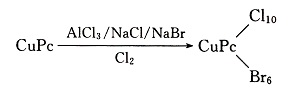
Pigment production process (1) halogenation In the halogenated pot, 105kg of copper phthalocyanine is added to a mixture heated to 150 °C by 437kg of anhydrous aluminum chloride, 175kg of sodium chloride and 28kg of sodium bromide, chlorine gas is introduced to constant weight under stirring, and the temperature is gradually increased to 190 °C within 3 hours, and the reaction is kept warm and stirred for 19h, and then 248L of chlorine gas is introduced. After the reaction, the molten reactant was poured into 110L hydrochloric acid and 4500L cold water, filtered and washed with water until it did not contain free acid, and dried at 100 °C to prepare 214kg of chlorobromide copper phthalocyanine. (2) Pigmentation adds the above-mentioned 10kg of solid products to 120L of 96% sulfuric acid, stirs at 0~5 °C for 16h, and then pours 1000L of water under 70~75 °C stirring, filters, dries, and prepares low-brominated chloride bromide copper phthalocyanine (containing 1.2 bromine atoms and 14 chlorine atoms in the molecule). Increasing the amount ratio of the reactant sodium bromide can increase the content of bromine atoms in the product molecule, such as yellow opthalocyanine green products containing 5.9 bromine atoms and 9.8 chlorine atoms. 3. Pigment technology formulation
| raw material | Dosage ratio |
| Copper phthalocyanine | 210 |
| Anhydrous aluminum trichloride | 874 |
| sodium bromide | 56 |
| sodium chloride | 350 |
| Liquid chlorine | 690 |
Use:
Polyurethane modified epoxy resin color paste, phenolic modified epoxy resin color paste, high temperature curing unsaturated polyester color paste, PU molding, silicone molding, buttons, imitation jade handicrafts. Automotive paint original factory paint (OEM), food packaging ink, plastic molding, rubber coating printing paste, lacquer cloth and other coloring.
Effect of No. 36 Green Car Paint:

Mr. Jia: 159-1691-0100 13360650502 Mr. Jiang:13924940045
Email:denson168@163.com
Address: Room 101, No. 1, Lane 11, Changsheng Street, Dalian Tang, Wanjiang Street, Dongguan City, Guangdong Province

备案号:粤ICP备19036602号 粤公网安备 44190002005999号 Copyright Dongguan DENSON New Materials Co., Ltd
