
Water-based colorants
Tailor made solutions for customers and create more innovative products for them

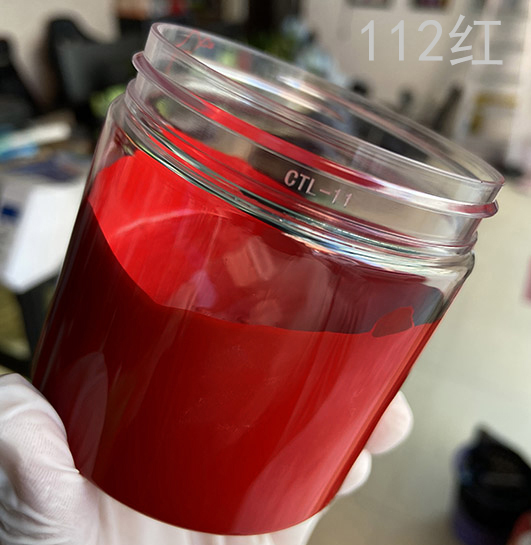
CI pigment red 112: permanent red FGR, is the main color of water-based colorant, colorant application, mainly used for water-based anticorrosive paint, water-based printing paste. Some products can be used in the production of water-soluble color pastes.
Aliases: pigment permanent red FGR
Catalog:Pephalophenol AS organic pigments Registry number:CAS[6535-46-2]; CI 12370 MF: C24H16Cl3N3O2 MW: 484.76 STRUCTURAL FORMULA: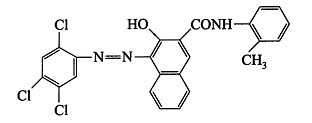
Pigment performance standards (colorant properties are similar):
| appearance | Bright red liquid |
| Shade | Similar to standards |
| Tinting strength/% | It is 100±5 of the standard |
| Moisture content/% | ≤1.5 |
| Water soluble matter content/% | ≤2.0 |
| Fineness (over 80 mesh sieve allowance)/% | ≤5.0 |
| Light fastness/class | 7~8 |
| Heat resistance/°C | 180 |
| Acid resistance/grade | 5 |
| Alkali resistance/grade | 5 |
| Water permeability/class | 5 |
| Ethanol permeability/grade | 5 |
| Paraffin permeability/grade | 5 |
| Oil permeability/grade | 3~4 |
Pigment properties: This product is a bright red powder. When concentrated sulfuric acid is reddish-purple, it is diluted to a blue-pink color. It has good light and heat resistance. Pigment production method: 1. Production principle 2,4,5-trichloroaniline is prepared by coupling with naphthol AS-D after diazotization.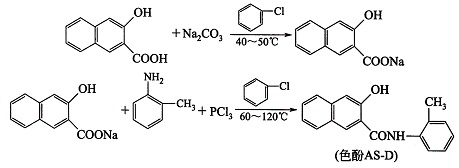
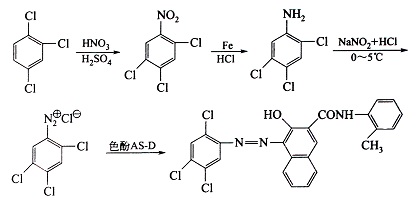
Pigment technology formulations
| raw material | Dosage ratio |
| 2,4,5-Trichloroaniline (industrial product) | 276 |
| Sodium nitrite (98%) | 98 |
| Naphthol AS-D (Industrial) | 420 |
3. Pigment production process (1) Preparation of pephalophenol AS-D Add 4300L of chlorobenzene, 630kg of 100% 2,3-acid and 280kg of sodium carbonate to the dehydration pot, heat to about 45 °C, heat up and dehydrate after the carbon dioxide escapes, the temperature rises to 134~135 °C, and the heating is stopped when the chlorobenzene is transparent and anhydrous to be evaporated, and the volume is controlled at 2900L. Press the dehydrated material into the condensation pot, cool it to about 90 °C, add 430kg of 98% o-toluidine, cool it to 65~70 °C, evenly add phosphorus chlorobenzene trichloride mixture (230kg phosphorus trichloride is prepared into 55%~60% mixture with anhydrous chlorobenzene), the temperature is 118~120 °C after adding, and keep warm for 2h. Add 1000L of water and 330L of 30% lye to the distillation pot and press the condensate in. After pressing, stir for 15min. The pH value is 8~8.5 by sampling, and if the pH value is lower than 8, alkali is added to adjust. Distilled with direct steam until the evaporate is clear without chlorobenzene. Add hot water above 90°C to 5000L and filter. The filter cake was washed with hot water above 90 °C until the filtrate was clarified, drained and dried to obtain 885kg of pepphenol AS-D. (2) Preparation of 2,4,5-trichloroaniline Add 1500kg of 95% sulfuric acid and 3000kg of 1,2,4-trichlorobenzene to the nitrification pot, stir and mix. Add 3000kg of mixed acid (HNO3 35%, H2SO4 65%) at 40~50 °C, stir at 48~50 °C for 2h, then add 150kg of water to dilute into 75% sulfuric acid, separate the upper oil, wash with water, and obtain 3650kg of crude product. Add 125L of water, 125kg of iron powder, 150kg of benzene, 150kg of pure trichloronitrobenzene and 1kg of formic acid to the reducing pot, and pay attention to the heating of the reaction from beginning to end to ensure boiling. If the material in the pot is shaken, 125kg of iron powder is added, if there is no oscillation, it will continue to be boiled by steam for 3h, and benzene will be siphoned out and distilled to produce benzene, and then 2,4,5-trichloroaniline will be distilled in vacuum. (3) Diazotization 500L of glacial acetic acid is added to the diazotization reaction pot, heated to 60 °C, and 276kg of trichloroaniline is dissolved in it. This solution was transferred to 3500L water, 1120L of 5mol/L hydrochloric acid was added, cooled to 0 °C with ice, and diazotized with a 40% solution prepared with 98kg of 98% sodium nitrite at a reaction temperature of 0 °C. After 2 hours, 107kg of light calcium carbonate was added to suspend in water, diluted to a volume of 8500L, 15kg of activated carbon was added, and filtered to obtain a diazonium salt solution. (4) Coupling: Dissolve 420kg of cropherol AS-D in 32.2L of 33% sodium hydroxide solution and 3000L of water. At a temperature of 90 °C, 10kg of diatomaceous earth was added, filtered, and diluted to a volume of 14,000L. Cooled to 3 °C with ice, 235L of glacial acetic acid was quickly added to acidify and precipitate the precipitate, and then heated to 38 °C to obtain the coupling components. Dizo solution was added to the coupling solution within 3 hours from under the liquid surface of the coupling component at a temperature of 38 °C. Filtered, washed with water, and dried at 50~55 °C to obtain 700kg of permanent red FGR.
Uses: Mainly used for ink, paint printing and coloring of stationery and educational utensils.
Thyssen color paste application, mainly used for water-based anticorrosive paint, water-based printing paste. Some products can be used in the production of water-soluble color pastes.
The migration resistance is relatively good, and the concentration is high. It is easy to disperse, has good storage stability in the later stage, and has high reconstitution performance.
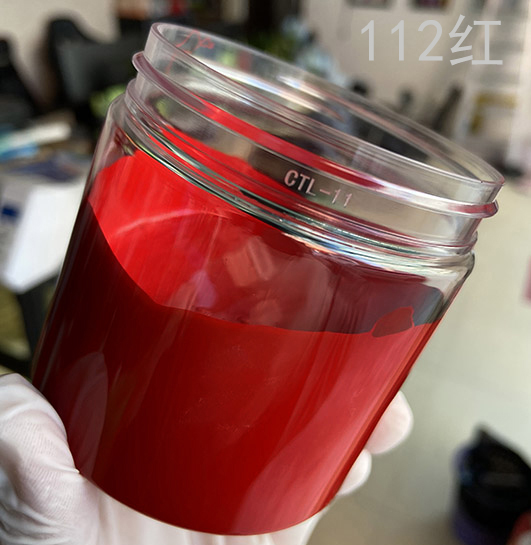
The finished colorant is as follows

Mr. Jia: 159-1691-0100 13360650502 Mr. Jiang:13924940045
Email:denson168@163.com
Address: Room 101, No. 1, Lane 11, Changsheng Street, Dalian Tang, Wanjiang Street, Dongguan City, Guangdong Province

备案号:粤ICP备19036602号 粤公网安备 44190002005999号 Copyright Dongguan DENSON New Materials Co., Ltd
